


PHICast
The How and Why of PHICast
Phi-Corrected, Assimilated, Syncretized Translator
Imagine a friend who can take your question and return a box of dreams, each related to your idea, but in ways you never imagined. THAT is PHICast!
As I was researching various subjects for a non-fiction book I am writing, I was struck by the power of AI, and the potential of how high-level physics and mathematics might be brought to bear on this emerging technology.
As an enthusiast of philosophy, metaphysics and quantum mechanics, and one who has read many books on these subjects, I enjoy looking for connections between otherwise disparate subjects and technologies. As I considered AI and its growth and development, I observed a lack of an overarching control system that might guide this technology at a systemic level toward greater efficiency—perhaps significantly so!
The following brief overview provides an introduction into the underlying theory and an exploration in basic terms into how the proposed system would both improve and expand the ability of AI to provide new modalities of knowledge exploration. The individual modules have been developed conceptually to work synergistically so as to ensure a deep exploration of a given meme, while remaining syntactically and semantically true to the intended ideation.
At this level of development, a team of experienced developers—with the assistance of AI—will bring this new technology quickly to market. It is believed this innovation will have the potential to drastically change how AI is viewed and utilized in the future. Serious developers and investors are welcome to explore this conceptual system model and consider getting in on the ground floor. This could be a Blue Water innovation!
Part 1: Executive Summary
PHICast: A Bio-Digital Framework for High-Dimensional Synthesis Core Innovation: The Phi-Corrected, Assimilated Syncretized Translator
I. The Problem Statement
Current Large Language Models (LLMs) operate on "probabilistic guessing," leading to "hallucinations"—outputs that are syntactically correct but ontologically hollow. As AI expands, the "Noise-to-Meaning" ratio is collapsing.
II. The PHICast Solution
PHICast introduces a Mathematical Constant (ɸ) as a governing heuristic. By utilizing Concept Vectorization Analysis (CVA), the system ensures that every creative "leap" is anchored in high-dimensional coordinate math.
III. System Architecture
The Semantic Anchor: Utilizing 512-dimensional Multi-Modal Embeddings to map Relational Proximity across Science, Lore, and History.
The Heuristic Guardrail: Dynamic Algorithm Configuration (DAC) detects "Scope Creep" and uses divergence scores to recalibrate the search path in real-time.
The Congruence Engine: The Vivification Module translates vector density into narrative meaning, ensuring that speculative outputs maintain an "organic" feel consistent with the Golden Ratio.
Part 2: The Table of Antonymous Abstractions
(Logic & Utility)
In traditional data processing, "divergent data" is discarded as noise. In PHICast, we recognize that the "Negative Space" of an idea is just as valuable as the idea itself.
The Logic:
When the CVA Module identifies a concept that has a high divergence score (moving away from the "Meme-Seed"), it doesn't delete it. It shunts it into the Table of Antonymous Abstractions (TAA).
Function: It categorizes what the seed is not.
Structure: If your Seed is "Order," the TAA captures high-density nodes of "Entropy," "Whimsy," and "Static."
The "Shadow" Benefit: For the user, the TAA serves as a "Lateral Thinking" tool. If the main search becomes too "stable" or "mundane," the engine can dip into the TAA to introduce "Controlled Chaos," sparking a new ɸ-corrected growth spiral.
Part 3: Use-Case Simulation (Meme-Seed: "Debt")
1. CVA (Concept Vectorization Analysis)
Input: "Debt" (Bias: Speculative)
Mapping: The engine plots coordinates between Economics (Negative Balance), Physics (Entropy/Energy Deficit), and Mythology (Karma/Sin/Pacts).
Discovery: It finds a "Structural Rhyme" between "Thermal Equilibrium" (heat death) and "Intergenerational Debt."
2. Vivification & Phi Correlation
Analysis: The "Density" is highest at the intersection of "Time" and "Obligation."
Warm Filtering: The engine recognizes that "Debt" in nature (predator/prey cycles) follows a ɸ spiral of balance. It rejects "Infinite Debt" as a hallucinatory/irrational path because it violates ɸ symmetry.
Translation: It enlivens the data into a "Case Study" of The Solar Debt.
3. The PHICast Result (The Output)
The Epistemological Model: "Debt is not a financial state; it is a Temporal Entanglement. Just as a star 'borrows' gravity to create light, human debt is the act of harvesting the future to illuminate the present. However, PHICast reveals that if the 'borrowing' exceeds the ɸ constant (1.618 of your current capacity), the spiral collapses into a black hole of 'Static Time.' To resolve debt, one must not seek more money, but more Symmetry."
A Deeper Dive:
Module 1: Concept Vectorization Analysis (CVA)
Rationale: In a holistic, cross-domain exploration engine as proposed, the need to ensure a consistent search process relevant to the desired subject query is key. By analyzing search progress in an iterative fashion, with a determinant function geared toward subject deviation detection, the potential for “scope creep” is significantly reduced.
Definition: A “Concept Vector” in this context is nothing more than the tendency of the system to produce output in a particular pathway relevant to the desired knowledge query. This analysis ensures that the engine is consistently discovering fresh data, while ensuring the data discovered is increasingly valuable pursuant to the quest for a rich, holistic dataset that satisfies the user’s input and bias decisions.
Alignment of vectors validate the engine’s algorithm selection or synthesis. Divergence or conflict indicate incursion into a knowledge area that is not likely to be productive. This would be indicated by increasingly lower analysis scores for discovered concepts or terms. In such cases, the engine would utilize dynamic algorithms, or dynamic algorithm configuration (DAC) to bring the model back into proper heuristic alignment.
Iteration provides a form of synthesized concept steering as outputs are reintroduced to the algorithms as fresh inputs, thereby inducing fresh data capture for further analysis. Recursion, in this context, is the mechanism by with a concept is tuned down to its base interpretation until the semantic and syntactic meaning becomes synonymous to the extent possible.
What is “Vectorization” in our App?
In standard AI, vectorization turns a word into a long string of numbers (a “vector”) based on how often it appears in other words.
Our Innovation: We don’t just use “standard vectors.” We use Multi-Modal Embeddings. As an example, we might plot the word ENTANGLEMENT in a 512-dimensional space where individual dimensions represent, for example:
Quantum Mechanics
Celtic Mythology
Biological Growth
And 509 other conceptual domains
The Synaptic Analysis Process
When the user inputs a “Meme-Seed,” the app performs three specific mathematical operations:
Cosine Similarity: Finds concepts that are “mathematically close” to your seed.
Dimensional Intersection: Finds where two disparate vectors cross.
Phi-Scaling: Adjusts the distance between nodes to match 1.618.
What This Achieves
Rather than simple storytelling, the system:
Extracts underlying structural patterns from physical laws
Analyzes the geometric properties of creative narratives
Synthesizes congruence between seemingly unrelated domains
This creates a semantic anchor that locates the idea’s position in conceptual space, while phi-filtering provides the structural coherence.
Rational Anchoring
The is not a speculative engine without base in known epistemology or human experiential reality. Utilizing high-dimensional coordinate math to prove that disparate concepts share a common structural “DNA,” the various models operate synergistically to ensure a relevant, potent, and dynamic output.
As the input is analyzed through the domains, knowledge points, connections and inferences are discovered. In the process, The Concept Vectorization Module drills down beyond definitions and seeks to discover Relational Proximity across 10,000+ dimensions, i.e., science, history, lore, art, etc.
Analytical triage identifies “structural rhymes”, or patterns where a given concept and a narrative trope share identical orientations. This “intentionality” is then used to determine:
A) is the resultant discovery set moving in a vector that is tending toward proper expansion and epistemological value relevant to the desired new discovery within the context of the subject meme,
Or,
B) is the process developmentally moving toward an outcome antithetical to the desired intent, thereby tending toward a progressive hallucinatory pathway.
Data that does not appear to be moving in congruence with the desired meme is flagged in preparation for further analysis by the Phi Filtration module.
Such nodes that lie beyond the realm of the desired ideation may be curated into a “Table of Antonymous Abstractions” that can be used later for potential alternative explorations.
Module 2: The Vivification and Phi Correlation Module
Vivification translates a spatial geometry (where concepts exist mathematically) into temporal narrative (how they unfold as meaningful stories or insights).
To ensure aliveness and congruency, the Vivification Filter translates cold vector intersections into measurements of density. High density intersections indicate a greater degree of interdisciplinary conflict, potentially yielding valuable but unexpected insights.
The output aims to create emphatic connectedness - a felt sense of meaningful relationship rather than mere data linkage.
Core Function: Transforms coordinates into consequences, making abstract relationships tangible and useful for human creativity and decision-making.
It makes the resultant epistemological model both potent and usable without delving into areas of little to no rational value.
The “North Star’ for Creative Discovery
Vivification provides orientation in chaotic spaces, helping users find spiral patterns of meaning without constraining exploration to overly narrow pathways. At the same time, meme alignment is attained through the interaction of all modules.
This avoids a mundane, conceptually bland experience.
Warm Filtering
Because Phi (Φ) is the bridge between the inorganic and organic it ensures the “speculative” output isn’t just fantasy, but an extension of the natural geometry already found in our reality.
As the engine moves through the domains, this filter ensures movement in correlation with the projected outcome as determined by the intentionality of the input. The intentionality is determined by the syntactical value of the original term(s) relevant to the bias selected, i.e., Hard Knowledge Bias, or Speculative Bias, as examples. Should the user elect for a Bias-Free exploration, the filter maintains rationalism by the assurance of movement through the domains that does not exceed a trajectory guided by the input’s definition and popular usage, within the bounds of the Phi constant. It is this ability to select bias that allows the filter to be tunable.
In essence, because the golden ratio appears throughout natural systems-from spiral galaxies to nautilus shells-it serves as a bridge between inorganic mathematics and organic reality.
The Phi filter ensures that:
Speculative outputs are constrained syntactically and rationally through innate spatial awareness of core knowledge spheres, thereby avoiding pure fantasy ideation
Movement through conceptual domains stays correlated with projected outcomes
Exploration respects the intentionality embedded in the original input
Warm Filtering
Because Phi (Φ) is the bridge between the inorganic and organic it ensures the “speculative” output isn’t just fantasy, but an extension of the natural geometry already found in our reality.
As the engine moves through the domains, this filter ensures movement in correlation with the projected outcome as determined by the intentionality of the input. The intentionality is determined by the syntactical value of the original term(s) relevant to the bias selected, i.e., Hard Knowledge Bias, or Speculative Bias, as examples. Should the user elect for a Bias-Free exploration, the filter maintains rationalism by the assurance of movement through the domains that does not exceed a trajectory guided by the input’s definition and popular usage, within the bounds of the Phi constant. It is this ability to select bias that allows the filter to be tunable.
In essence, because the golden ratio appears throughout natural systems-from spiral galaxies to nautilus shells-it serves as a bridge between inorganic mathematics and organic reality.
The Phi filter ensures that:
Speculative outputs are constrained syntactically and rationally through innate spatial awareness of core knowledge spheres, thereby avoiding pure fantasy ideation
Movement through conceptual domains stays correlated with projected outcomes
Exploration respects the intentionality embedded in the original input
Bias Management
Users can select exploration biases:
Hard knowledge bias: physics, matter, empirical data
Speculative Bias: lore, fantasy, creative reasoning
Bias-free Exploration: Maintains rationalism through adherence to the input’s standard definition and usage, bounded by phi constraints
The Bottom Line:
The emergent, previously Unknown Epistemological Model generated is preserved in a rationalized, relational ideation abstraction; modulated, governed and mentored by a recursive analysis mechanism that is closely integrated and supportive of a highly tuned, results-oriented synthesis, insight and discovery machine.
The Bottom Line:
PHICast is the world's first Bio-Logical Intelligence adjunct. While other AIs prioritize prediction (what word comes next?), PHICast prioritizes congruence (what idea belongs next?). By utilizing the Golden Ratio (ɸ) as a mathematical guardrail, we eliminate the 'hallucination gap' and deliver synthesized insights that are mathematically grounded in the laws of natural growth.
On the following pages are two concept cards that provide a compact, concise, systemic sketch of the proposed technology conceptually and in practical application.
PHI-Filtered Concepts:
Syncretism: Based on the physics of superposition, where particles exist in multiple states simultaneously. It draws from the lore of Hermes, the "God of the Crossroads," and teaches that truth is found in the interference pattern where worlds overlap.
Entanglement: Rooted in non-locality, where linked particles share one existence. It connects to the myth of the "Red Thread" of destiny, suggesting that distance is a sensory illusion and that one can align with their goals by matching their resonance frequency.
Entropy: Based on the Second Law of Thermodynamics regarding energy dissipation. It aligns with the lore of the Phoenix, illustrating that decay is a necessary "recalibration" for new growth within the Golden Spiral.
Resonance: Derived from the physics of harmonics and sympathetic vibration. It relates to the mythic concept of the "True Name" and posits that influence is about matching the congruence frequency of a desired reality.
Horizon: Based on the Schwarzschild Radius (the point of no return). It connects to the myth of "The Edge of the Map" and suggests that boundaries are where the known meets infinite potential and where true creation occurs.
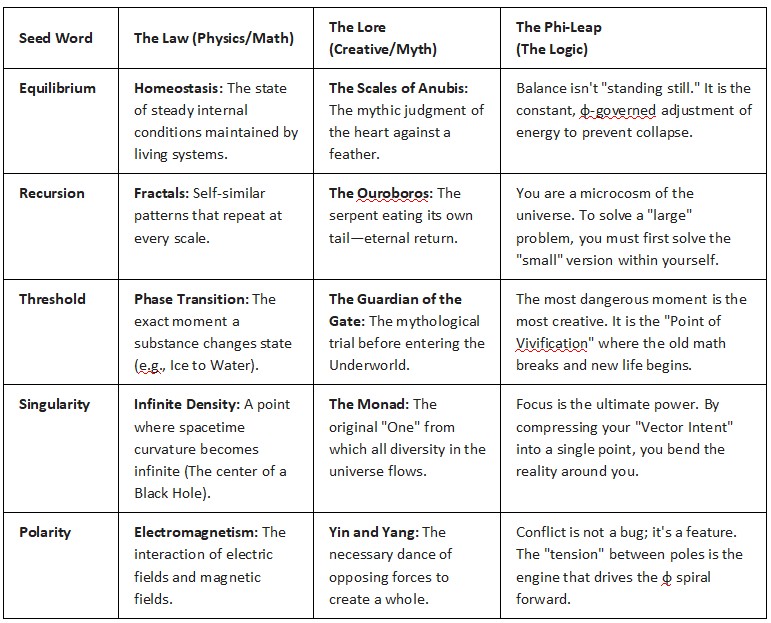
Conceptual Seeds:
Interested?
We are currently seeking interested developers and investors to explore the potential development and market launch of this ambitious enterprise. This may be a Blue Water innovation, and it is anticipated that early investors could see tremendous returns.